Digital Asia: Autoethnography #4 Hi Score Girl (2018-2019, Japan)
So this week is an Anime! The Show is Hi-Score Girl, and focuses on the relationship of two young children growing up during the 90’s at the height of the golden age of gaming. An era where games such as Street Fighter 2 was at it’s height for popularity. Now the show was only viewed from the first 4 episodes, I feel this is a necessary disclaimer when it comes to TV shows, as if it was a standard length movie, it’s the equivalent of watching the first 24 minutes and judging the whole thing based on that.
So this is definitely a lot more of a broader look at Japanese games and movies, and some elements of mythology that may be missing from a western perspective. But curiously, a fact that escaped me while originally watching this media, was the prevalence of roman letters and the English language in the way media was branded and used.
This actually stems from a school of Japanese design, where the mixing of languages is seen as a way to enhance the aesthetic qualities of a given design, as detailed by this article here.
Interestingly in Anime the hitting on the head that is prevalent so often in comedy anime actually stems from a comedy routine from the Heian Period (800 AD- 1200 AD) called Manzai, in which the common recurring joke is the hitting on the head. Interestingly this evolved into the Kabuki plays during the Edo period, where the stage actors used exaggerated monologues, strutting and posing, with heavy face paints to exaggerate their expressions, and battles of posing and heroic dialogue.
The final point this article points out is the concept called “mono no aware” which is an understanding of impermenance, where nothing lasts forever; an element that becomes a heavy theme in stories involving love and other forms of media.
So based on this study while autism is a natural aspect of people in all societies, and that there are some universal indicators of possessing these traits; culture actually makes a huge difference to how these traits are perceived, and expressed. In Japan for example spontaneity is a natural aversion for their culture, and so was less effective at differentiating the children on the spectrum from the control group.
“In Japan, the schools allowed us a lot of freedom within discipline. We did not use textbooks, and instead we worked on one college-level math problem in class from different perspectives or we did research on our interests and presented them in class for social studies. It allowed me to be myself in some ways, but I did not feel comfortable being in class due to sensory issues. Ballet, which I have been doing since I was 3, also hid my autism.” – Kana Umagami, 2017
Interestingly, while culturally people on the spectrum may not be accepted and understood openly in Japan, particularly during the period this show is set; according to multiple sources Japanese culture as it is, is considered much more friendly to people on the spectrum; with the formality and respect of others privacy and quiet, and the way anime explores social issues with easy to understand expressions, and lessons on friendships.
References
Anime | aminoapps.com. 2020. West On The East: Western Influence On Japanese Media | Anime Amino. [online] Available at: <https://aminoapps.com/c/anime/page/blog/west-on-the-east-western-influence-on-japanese-media/3YtB_ugXxDLNKgW4600vJmYd32xLmX> [Accessed 30 August 2020].
Blogger, G., 2020. AUTISM IN JAPAN: WHAT TO KNOW. [Blog] Inside Japan, Available at: <https://www.insidejapantours.com/blog/2018/03/30/autism-in-japan/> [Accessed 30 August 2020].
Hiraiwa, M., 2016. Japanese Trend in Childhood Treatment for Autism Spectrum Disorder. Austin J Autism & Relat Disabil., [online] 2(4):(1027.). Available at: <https://austinpublishinggroup.com/autism/fulltext/autism-v2-id1027.php> [Accessed 30 August 2020].
IMDb. 2020. Hi Score Girl (TV Series 2018– ) – Imdb. [online] Available at: <https://www.imdb.com/title/tt8963328/> [Accessed 30 August 2020].
Lefler, R., 2020. 8 Reasons Why Autistic People Are Drawn to Anime and Fandoms. Reel Rundown, [online] Available at: <https://reelrundown.com/animation/Why-Are-Autistic-People-Drawn-to-Anime> [Accessed 30 August 2020].
Molecular Autism, 2018. A Cross-Cultural Study Of Autistic Traits Across India, Japan And The UK. Molecular Autism, pp.https://molecularautism.biomedcentral.com/articles/10.1186/s13229-018-0235-3.
Razeek, F., 2019. 7 Graphic Design Trends in Japan You Should Follow. [Blog] Design Wizard, Available at: <https://www.designwizard.com/guest-blogs/7-graphic-design-trends-in-japan-you-should-follow/#:~:text=Language%20Mix,mixed%20languages%20in%20their%20work.&text=Most%20Japanese%20designs%20consist%20of,text%20mixed%20with%20Japanese%20characters.> [Accessed 30 August 2020].
Stevens, K., 2011. Of Divine and Digital Origin: Mythology in Japanese Video Games. [Blog] Post Bubble Culture, Available at: <https://postbubbleculture.blogs.wm.edu/2011/04/10/of-divine-and-digital-origin-mythology-in-japanese-video-games/#:~:text=Capcom’s%202006%20release%20Okami%20is,the%20divine%20origins%20of%20Japan.> [Accessed 30 August 2020].
Tips, C., 2020. Otaku: What Is The Otaku Culture In Japan?. [online] Jw-webmagazine.com. Available at: <https://jw-webmagazine.com/otaku-what-is-the-otaku-culture-in-japan-2283995b38c0/> [Accessed 30 August 2020].
Umagami, K., 2017. What It Was Like to Grow Up in Japan With Undiagnosed Autism. The Mighty, [online] Available at: <https://themighty.com/2017/10/living-with-autism-in-japan/> [Accessed 30 August 2020].
Von Lanken, K., 2016. Traditional Culture Exemplified in Modern Japanese Media. [Blog] Gaijin Pot, Available at: <https://blog.gaijinpot.com/traditional-culture-exemplified-in-modern-japanese-media/> [Accessed 30 August 2020].
Digital Asia: Autoethnography #3 Cake (2018. Pakistan)
So this week the screening was about Asim Abbasi‘s ‘Cake’, a drama, mystery from Pakistan.
So the political climate for the LGBTIQ+ community in Pakistan is a mixed bag, on the one hand they recognise the third gender; as it is traditionally called Khawaja Sira or Hijra, which is different to western ideas of Transgender, and is considered a normal and accepted form of identity for those that were born and assigned male; but does not formally recognise those who were born and assigned female, and until recently (around 2018 around the same time as this movie) meant the sacrifice of a lot of social rights in regards to voting, and inheritance of property.
This appears to be mostly from the fiercely patriarchal society that affords males in Pakistan a preference for inheritance, among many other privileges. This is also compounded by the illegality of same-sex intercourse (but critically not relationships), with the death penalty still the official form of sentencing for those that are charged.
While it has been touted by several newspapers that these charges are infrequently enforced, and sentencing for many have been markedly less harsh (in 2011, 2 people were sentenced 10 years in prison); this severe hate towards the LGBTIQ+ community is reflected in the treatment by many civilians, as it has been reported that police will often turn a blind eye to accounts of abuse towards those from the LGBTIQ+ community.
But on to a bit of a lighter note, onto the second tweet.
During the viewing I did not hide my distaste for the editing and audio mix, I initially loved the music and appreciated the romantic style audio; but I assumed it was used for narrative weight but found that this music was used universally throughout the film. Pakistan much like India’s Bollywood, has it’s own style of film and appreciation for film qualities, known as Lollywood.
According to this article about the major differences between the two film industries; while the two were initially cut from the same cloth, an example of why the film Cake uses such theatrical music throughout the film, and that the editing style and story is almost a larger than life representation, Lollywood, as it has grown especially in the last few decades, has had a greater focus on accurate representations of social drama, and a focus on smaller tighter scripts, as opposed to the long spectacles of it’s neighbouring Bollywood.
And so with this the Lollywood scene is producing more films that have appeal and recognition as they try new forms of storytelling, in contrast to the majority of Bollywood films, which are made to satisfy their existing audience, and not challenge them.
This structuring of Lollywood film practices is also prevalent in it’s use of language.
While this statement by me isn’t wrong per say, this article here actually details that the multilingual nature of Lollywood films actually stems from a cultural hierarchy of language, in which certain languages are represented as being higher than others. In this English is seen as the top, followed by Urdu, followed by regional languages, but Hindi is almost never used in film. Even the accents of the people in the films, is designed to be as an ‘educated, urban, standard Urdu’.
References
Azhar, M., 2017. Pakistan’s traditional third gender isn’t happy with the trans movement. TheWorld, [online] Available at: <https://www.pri.org/stories/2017-07-29/pakistans-traditional-third-gender-isnt-happy-trans-movement> [Accessed 30 August 2020].
Equaldex.com. 2020. LGBT Rights In Pakistan | Equaldex. [online] Available at: <https://www.equaldex.com/region/pakistan> [Accessed 30 August 2020].
Humandignitytrust.org. 2020. Pakistan | Human Dignity Trust. [online] Available at: <https://www.humandignitytrust.org/country-profile/pakistan/> [Accessed 30 August 2020].
IMDb. 2020. Cake (2018) – Imdb. [online] Available at: <https://www.imdb.com/title/tt7715988/> [Accessed 30 August 2020].
Looch, C., 2019. Why Pakistan’s Lollywood Is Better Than India’s Bollywood. Culture Trip, p.https://theculturetrip.com/asia/pakistan/articles/why-pakistans-lollywood-is-better-than-indias-bollywood/.
Lynch, L., 2018. “There’s Research on That!” Gender, Identity, and Pakistan’s “Third Gender”. The Society Pages, [online] Available at: <https://thesocietypages.org/trot/2018/07/03/gender-identity-and-pakistans-third-gender/> [Accessed 30 August 2020].
OutRight Action International. 2020. Pakistan. [online] Available at: <https://outrightinternational.org/region/pakistan> [Accessed 30 August 2020].
Rahman, T., 2013. The Languages of Lollywood. Himal South Asian, [online] Available at: <https://www.himalmag.com/the-languages-of-lollywood-pakistani-cinema/> [Accessed 30 August 2020].
The Express Tribune. 2020. Everything You Always Knew About Lollywood | The Express Tribune. [online] Available at: <https://tribune.com.pk/article/6191/everything-you-always-knew-about-lollywood> [Accessed 30 August 2020].
Digital Asia: Autoethnography #2 Furie (2019. Vietnam)
Oh boy do I love martial arts movies, and this one is awesome, thoroughly recommend. Sorry couldn’t help myself, onto the auto ethnography of this gritty and stylish action film by Vietnamese Director Le-Van Kiet.
So first point of cultural difference I wanted to look at was the apparent matriarchal culture portrayed in this film, whether that was part of a traditional viewpoint, or a new revolution in gender roles; and also the inclusion of younger family members as full humans of independent thought and opinions, and not a shelter culture where children are intentionally kept in the dark.
In this regard I found two different ideas of matriarchy vs patriarchy. First I will talk about Vietnam as Patriarchy, freshly informed by this article here, in the more built up areas of Vietnam, i.e. Cities, the people were more heavily influenced by the impacts of colonialism from the Chinese, and Confucianism, robbing what was a more traditionally Matriarchal society, and imparting the rules against education and therefore work for women.
However in contrast, as reported by VovWorld, the matriarchal societal values is still actively practised by traditional ethnic groups in the more rural areas of Vietnam. Considering much of this movie takes place in these rural areas, I feel it isn’t unreasonable to assume that this has been taken directly from this aspect of Vietnamese society; at the very least unintentionally as a result of these cultural aspects in the larger society.
In regards to the parenting culture to quote SBS World Atlas
“Traditionally, children do not keep any secrets from their parents as most information is shared within the family. However, children whose moral or ideological opinions differ from those of their parents will generally keep their views to themselves. “
So my initial reaction was fairly accurate, children in general are given a more important and active role in the general activities and care of family members.
So luckily (as evidenced by the above) I do actually have some previous experience (not as a practitioner) with the primary martial art used as inspiration for the choreography in this film. But after some research into the source of Vovinam, while a lot of it’s techniques were taken from traditional weapons and techniques within Vietnam, but also taken from Chinese, Korean, and most controversially at the time, Japanese techniques.
The form was introduced in 1938, and was created to be easy to learn to empower the people of Vietnam, this was partially because around that time, they were being invaded by the Japanese; and this pride and resentment would of made the origin of many of the Vovinam techniques a sore spot for people of the time, and so the founder Nguyen Loc, kept this hidden.
Another interesting aspect of Vovinam in a more fun fact kind of way, in contrast to a lot of perceptions, White Belt in Vovinam is actually the highest belt. But it was really cool to see this martial art form represented in media, with it’s focus on agility and speed creating some extremely flashy fight scenes.
Enjoy this competition match of Vovinam as a farewell present for the week.
Bibliography
References
Cultural Atlas. 2020. Vietnamese Culture – Family. [online] Available at: <https://culturalatlas.sbs.com.au/vietnamese-culture/vietnamese-culture-family> [Accessed 28 August 2020].
Danang Property, 2019. The formation and development of the patriarchy in Vietnam. Medium, [online] Available at: <https://www.integral-vovinam.com/2integral_concept/3ic-no_nonsense_technique/3ic_no_nonsense_technique.html> [Accessed 28 August 2020].
Hays, J., 2020. CHILDREN IN VIETNAM | Facts And Details. [online] Factsanddetails.com. Available at: <http://factsanddetails.com/southeast-asia/Vietnam/sub5_9c/entry-3391.html> [Accessed 28 August 2020].
IMDb. 2020. Furie (2019) – Imdb. [online] Available at: <https://www.imdb.com/title/tt9412268/> [Accessed 28 August 2020].
Integral-vovinam.com. 2020. Integral Concept. [online] Available at: <https://www.integral-vovinam.com/2integral_concept/3ic-no_nonsense_technique/3ic_no_nonsense_technique.html> [Accessed 28 August 2020].
Müsker, P., 2020. Vovinam Viet Vo Dao – Vietnamese Martial Arts. [Blog] The Warriors Travel Guide, Available at: <http://thewarriorstravelguide.com/vovinam-viet-vo-dao-vietnamese-martial-arts/> [Accessed 28 August 2020].
Nga, T., 2013. Cham matriarchy. VovWorld, [online] Available at: <https://vovworld.vn/en-US/colorful-vietnamvietnams-54-ethnic-groups/cham-matriarchy-176290.vov> [Accessed 28 August 2020].
Sports Know How. 2020. The Story Of Vovinam | All About Vovinam | Origin Of Vovinam. [online] Available at: <https://sportsmatik.com/sports-corner/sports-know-how/vovinam/> [Accessed 28 August 2020].
Digital Asia: Autoethnography #1 Love for Sale (2018. Indonesia)
So this first viewing is Love For Sale, a 2018 film by Indonesian Director, Andibachtiar Yusuf. Before we get started if you haven’t already I would suggest reading my first post in this series to provide some personal context on my understanding.
So first tweets I would like to analyse is this.
Now these two tweets are obviously quite linked, socioeconomic class, and aspirations of work. It’s interesting seeing this high focus on the middle class workers of Indonesia, as detailed in the article by World Bank; the middle class is actually an expanding class in Indonesia, with 80% of the people who were identified as ‘poor’ in 1993, by 2014 were no longer apart of the demographic, and in this explains the pride in the work culture that the film portrays.
Another thing that I had noticed while watching was this reverence afforded to the main character as an employer; abuse was expected and criticism was never given. Using the website Paul Hype, a Singaporean Consultant (side note, both the film and this website feature WhatsApp, pretty heavily), this stems from a culture of the employer and the employers pride being of central importance in their culture, and so criticism is expected to be withheld, and the standards set by these employers isn’t necessarily expected to be met by the employer themself.
As a note on the relationship culture, the film relies heavily on this idea of a long courtship between the main character and Arini, and only shows this newer side of casual dating that apparently has become less popular. Quoting Asimonoff, a blogger on the Indonesian Language Blog
In Indonesia, where family plays an important role in partner selection, a courtship and finding the right partner is a family affair. Most parents believe that the best candidates for their future daughter or son-in-law should have a good background based on the crucial aspects of “Bibit, Bebet, Bobot” which has a Javanese origin, referring respectively to family wealth, social rank, and ancestry. Parents believe that their future in-laws should at least come from the same social status and religion.
But also in some research that will now forever be a blight on my Google Search History, “sugaring” is actually an increasingly popular practice in Indonesia, particularly in the same city that this movie takes place. Vice reports that more than 10,000 young females on one of the most popular sites in Jakarta alone, with less than half that from males on the same site.
This is touted because the gender pay gap is on average 27% lower than males in similar positions, and many of these people seek a higher education. This actually ties itself quite well with the first post; a lot of the females that were shown in the film appear to be in a worst economic and professional state than the men in the film. With Indonesian culture a growing economy with a rising middle class, but still a growing infrastructure to support it’s citizens, this practice of ‘sugaring’ from both a ‘daddy’ and ‘baby’ perspective (I feel dirty typing that) becomes an understandable growth from a rising cultural force.
Bibliography
Blogs.transparent.com. 2020. Love And Courtship In Indonesian Culture. [online] Available at: <https://blogs.transparent.com/indonesian/love-and-courtship-in-indonesian-culture/#:~:text=Even%20though%2C%20they%20are%20involved,with%20friends%2C%20siblings%20or%20family.&text=They%20don’t%20show%20physical,just%20holding%20hands%20in%20public.> [Accessed 28 August 2020].
Company Incorporation and Setup in Indonesia. 2020. Indonesian Work Culture | About Indonesia. [online] Available at: <https://www.paulhypepage.co.id/indonesian-work-culture/> [Accessed 28 August 2020].
IMDb. 2020. Love For Sale (2018) – Imdb. [online] Available at: <https://www.imdb.com/title/tt8065796/> [Accessed 28 August 2020].
The World Bank, 2020. Aspiring Indonesia: Expanding the Middle Class. [online] Available at: <https://www.worldbank.org/en/country/indonesia/publication/aspiring-indonesia-expanding-the-middle-class> [Accessed 28 August 2020].
Vice, 2020. Sugar Dating Gains Popularity in Indonesia As More Youth Seek Comfortable Lifestyles. [online] Available at: <https://www.vice.com/en_us/article/ep4kj7/sugar-dating-indonesia-popularity> [Accessed 28 August 2020].
Digital Asia: Auto Ethnography #0, Primer
So this isn’t an auto-ethnography based on reactions to media from another culture; but like a fine painting the primer is important; to provide context both to the following posts without having to explain the process each time (hooray for being laz…efficient), but also as a kind of background into my own cultural viewpoint, and so have an understanding of how I respond to these texts.
So First
The Process
So the process that this auto-ethnography process will take is first a live viewing of a selected media through my twitter account, I will throw up all the thoughts that I think at least warrants the 30 seconds for me to type it there, and respond to some other peoples who are also viewing the tweets at the same time.
After the viewing has finished, I go through and pick out the key tweets to do with cultural views and observations, and anything of any sort of mild interest; look up the meaning of these observations and comments, and place back into a blog post on the final reflections of my own response to the media and culture.
My Own Cultural View
So without going into a full auto-biography; I am a 26 year old male student of graphic design, with interests in games, movies, science, animation, fiction, art, and martial arts; the more of these words that can be used to describe something, the more I will like it. While I was definitely raised within a White Australian background, I myself actually come from mixed heritage of Chilean and Australian, and without sounding too soppy, never fit fully with either.
So my cultural views especially as I have gotten older; at least from my perspective; share very little in common with culture in general, and I mostly try to be as objective and factual as I can; and actively change or ignore any viewpoints that I recognise to be from any sort of purely cultural perspective.
Now obviously, I am not a robot; as far as you all know with COVID-19 going on, I haven’t been seen in days; so this isn’t possible, and will always have elements of the cultural understanding that I have been raised in, interacted with, and media I’ve consumed. But I make a diligent effort to recognise these, and change them when they appear.
Well, onto the content!
VCD 302: A Post-Mortem
The Minotaur is a short ‘what if’ teaser for a potential animation project, it shows a world and creates interest in a short animation production that will evoke both wonder and fear. The animation is made of four major parts, the introduction speaks to the wonder side, and shows the colourful and beautiful world, the middle animation is a peek at a more minimalist type that would become a key branding mark of the final work, followed by a contrasting gloomy and bleak undergrowth, that sets up the key conflict and essence of a potential full animation, and a final cerebral outro, a reiteration of the key minimalist visual approach that can be used to convey non-physical story elements in a way traditional film techniques couldn’t.
The work uses traditional cel animation style, mixed with digital techniques in world building, and functions primarily on the strength of colour and lighting to construct the world and characters.
So maybe I am being a little dramatic, but it is a breakdown of the work I have done, which, for the majority of it I am quite happy with.
Technical achievement
On a technical level, I am incredibly happy with the final result, ultimately the final fidelity of each individual frame I feel could be a lot higher, and the final Minotaur at the end of the short animation could of been more bespoke in animation, instead of tweening the motion of a single drawing, but as an overall teaser and evidence of understanding of motion fundamentals I believe the work is really good. I utilised several major programs and imported and translated between them a lot, such as After Effects, Toon Boom, Premiere Pro.
Implementation of motion design fundamentals (primary, secondary, temporal)
The motion design elements used really created a good sense of the emotion I was trying to invoke, while I did use a fair bit of smearing and compression to convey motion, I also implemented a way to more closely create a sense of a horror movie, particularly in the second half of the animation. This was done by using a technique stolen from Spiderman: Into the Spiderverse, where the character was actually animated on 2’s, this did make the workload a lot less, but it also conveyed a nervousness that I wanted present in the character. The initial relaxed shot, was actually animated at 24 Fps, but was dropped to 12 or even less when trying to convey that stiff nervous reaction.
Animating each frame with less smearing and compression on average, was actually done to make the movements feel more deliberate, a slow crawling progression, rather than a explosion of movement. Smearing and compression actually proved to be the easiest way to animate the scenes, than fully redrawing the entire body each frame, but would of taken away from the slow momentum I was trying to achieve, except in key spots of explosive energy.
Design / aesthetic outcomes
Overall design wise the shots are a little messy, and not as polished as I would like, but still maintain a basic idea of composition and rule of thirds framing, utilising similar perspectives and visual organisation all the way through, so as to maintain a smooth visual flow between cuts. Colour is separated into two major sections, the almost fever dream bright colours and visuals of the first sunset shot, to the gloomy blue and dark’s of the undergrowth.
Project goals – did you meet your own objectives for this project? Did you meet your own brief? How did it succeed? Where did it fall short?
I believe as a baseline skeleton for a full shot I achieved the critical areas that I was attempting to explore and succeed in, create a sense of narrative, and explore techniques that I had little experience in, and combine them into a multimedia production. The individual frames quality of drawing definitely fell short of what I would be happy to show off, but the guidelines for the motion and the ‘skeleton’ of this is solid enough to be built upon and I believe that makes this project a success.
Learning opportunities/analysis


So there were three major learning points and areas that I feel I definitely could learn to improve on. As touched upon earlier in this post, I definitely feel taking more time to draw each shot and pay more attention to the structure of each individual frame/drawing, would be a major thing to keep in mind. Working with a digital tablet is still relatively new to me, and the frames were very much quickly drawn out, which lead to inconsistent proportions and structure that I feel weakened the sense of reality in the characters in the physical space; and given a chance to redo the project, I would instead spend more time on using phsyical mediums to storyboard with a higher degree of detail, so that process of experimentation in form can be more fluidly approached instead of in a digital space.


I also learned that while inconsistencies of drawing in physical forms and structure, can become unnoticed in an animation consisting of 24 drawings a second, this is not true for the colour or lighting, and this requires consistency. With this in mind I definitely should of approached shading and lighting each frame in a more careful way.

The other thing I believe I noticed in hindsight, is I am infinitely more comfortable working with type, and it would of been exciting to incorporate this more throughout the entire project, as it definitely feels to be the strongest single aspect of this particular project, and it would be interesting to incorporate these into the work.
Future
In the future I believe that I would take a lot more care in the individual fidelity of my drawings, as I focused a lot on the other aspects of the work, and less on maintaining solid structure in the forms throughout the project, despite this being a strength I usually have. I will definitely be expanding my animation work, and have learned a lot from the animation piece.
VCD 302: In Progress
I recently found this teaser for film called Klaus, it uses a revolutionary technique for 2D Animation that involves lighting and shading as if it was 3D rendered. It creates a very stark and iconic visual style, that while I doubt I will be able to achieve, I at least hope to have some level of emulation to what they have done.

How is it Progressing?
This is an example frame from Toon Boom that I am using to show off some of the stretching and light smearing that will be present in the final product. The product stylistically, is a almost offbeat horror themed animation, and with this in mind, the animation won’t feature a lot of distortion of form, but will still have a lot of compression and smearing to show off the motion that is present.

Type has been integrated into the animation now as well, it has a combination of ‘wobbliness’ and a shifting type face, to convey a almost hand-drawn aesthetic to the piece.

And this is a particularly strong example both of the new background the final section is using, but also the most exaggerated smear and compression in the animation piece, it really gives a sense of the impact from hitting the ground.
Some effects I used to make the undergrowth scene, feel as if it was a part of a forest under a canopy, was a use of randomly generated geometric shapes as an overlay, as little specks of light entering through and lighting some sections of the scene up. I think this helps with the atmosphere of the project.

I did have some minor issues with the program being used to draw these animations, as it struggles to render out a video over a certain number of frames. This was solved by rendering out the animation as a series of images, which can then be imported into Premiere Pro, at a speed of 24 FPS, and this can then be rendered out as a final video.
I also have gone through the process of making my own musical score for the piece! I am far from a trained composer, and am not a naturally musical person, but I wanted a piece that matched the feeling and beats of my Animation.
Now one issue I am having with the animation is I created some lighting and shading on each frame, which looked fine while animating, but after rendering and watching back, has a heavy strobe like effect as each frame is different. Normally when doing motion these smaller differences don’t make a huge impact in the final animation, as the drawings I used as a base were very rough but once in motion, didn’t make a huge difference to the overall fidelity; this is not true for lighting and colour though, and so I am going to go through and remove as many individual frames as I can.
BCM 300: Cosmic Mercenaries Dossier

Introduction
The design has a few design goals in mind; replayability and unique playthroughs in a limited materiality box, create a game that can be competitive with lots of strategy and choice involved and nuance in each decision, and a game that can still be accessible for someone who doesn’t have a lot of experience in boardgames.

Early Draft Map and setup
These elements are obviously very contrasting and perhaps even contradicting. For example the limited materiality and large amount of replayability; not including the difference in moves each game like a chess match for example, but the characters and what those characters can do and the very map they are on are all designed for an essence of randomness, more akin to a procedural generation than a true random, ensuring that when players begin that no two games will be the same, which has become a bit of a redundant catchphrase, but more than focussing on the statistical number differences that means no two games will be the same, I wanted to create games where they didn’t ‘feel’ the same.


This was attempted to be done by ensuring players have a very obvious and large goal as to the victory condition, but left it open as to the methods of that victory. Perhaps their crew is built to go in guns blazing storming through walls and doors in a slapdash run; perhaps they are more coordinated using careful planning to minimise risk to themselves; maybe the crew is completely unique and have ways avoiding combat altogether. The game is designed to reward experimenting with a wide range of abilities and effects to create a playstyle all their own. This is why the drafting stage (which will be elaborated on later) gives players a limited choice, giving players a sense of control and agency, while not letting their own inhibitions and preconceptions shackle their own sense of experimentation.
The game in this replayability relies on a sense of randomness, dice rolls and card draws that tend to be seen in a negative light when viewed from a competitive players stand point, competitive players in any game look for reliability more than anything. Winning by one point 90% of the time is better than winning by 100 points half the time. Where this is curtailed and managed in this system is a kind of limited probability in that players still have control during those random events, or in the chaos phase, an ability to see how that chaos phase may go based on the environment; so it never feels like a truly random event, and that the player could of seen that coming.
The other way the competitiveness and replayability is managed is the random elements are never interfering with the players action directly, the player never has a moment of rolling a dice and getting too low of a number, direct actions are all static numbers and perfectly predictable, but instead these random elements affect the game board, allowing players the freedom to circumnavigate this dangerous environment how they see fit. Having this chaos phase is a key element to allowing the game to be different every time, but without having to rely on elements that negatively affect the individual player experience in terms of control and agency.

Box with all the prototype pieces and cards.
The other aspect of the game is accessibility, part of this accessibility will be through the material inclusion of the game screens, functioning as a propellant of some of the games features inspired from hidden movement games and hidden agenda games, and hiding the cards the player has in hand at the beginning of the rounds, which will have a cheat sheet on how to play on the inside. The other way accessibility has been maximised is the game uses really simple maths, only adding or subtracting numbers as they appear, with little reliance on modifiers and other mathematical tricks to convey depth. And finally all numbers on each character can be represented by a simple d6 die, making tracking Action Points and Health Points easy with multiple characters with materials provided by the game.
What is the game?
These are all the mechanical elements that was kept in mind when creating this project, and do provide a cohesive interplay of systems that ensures the replayability and competitiveness that the game can present. But the way these systems express the theme and narrative the game is trying to explore also ties well with the systems chosen.
The theme is about a crew of mercenaries and salvagers at the edge of space, trying to get paid, but also not die. You are a cog in the machine of the larger mega corporation Finnegan’s Beer™ and just like your crew, you are expendable. Games are rife with high damage and quick firefights, that ensures that your game can be over in a flash, but these mercenaries really are a dime a dozen, for every Fired Tax Accountant and Mechsecutive that made a bad decision and ends up as a mercenary, there is another around the corner waiting to take their place.
The randomness and chaotic nature means as the board shifts and moves, representing the shipwreck being torn apart, that it means this unpredictability could mean your mission is over straight away, but again you have reinforcements on the way to replace any casualties. The game is tight and controlled with a frantic pace, almost a volley between players in tennis, it is a consistent and fast paced back and forth, with the chaos phase ironically being a time of peace for players to rethink, and maybe pray that the ship bends fortune back into favour for them.
All of this happens as the ship slowly careens to the Event Horizon of the Black Hole ‘Xibalba III’ and eventually succumbs to its fate.
This all fits neatly in an emergent player narrative of rising chaos as events slowly unfold, at an exponentially more chaotic and dangerous rate. Opening a 3 act structure of exploration and discovery, struggle and conflict, and finally panic and survival.
Design Process
The game actually began as two separate games, one based on the system of a shifting board map, and the other on the card drafting hero builder. But eventually the two thoughts were collated into one; the drafting aspect was heavily inspired from custom game mode in Dota 2, called Custom Hero Chaos. The game used the cards less as the central mechanic and as the mechanic characters were built. Cards was chosen so that the game was light on rules and pre reading, and gave a sense of intuitiveness to the overall gameplay by allowing people to directly see the effects in front of them, instead of front loading all the information in rulebooks, and allowing exploration of new mechanics to become more organic.
The second game it started as was a simple treasure hunt movement game, with a shifting map like an older game called Labyrinth. The core of the game was getting a team safely out of the map. This game was extremely simple in terms of supporting systems, and mostly revolved around this moving map mechanic. The game theme was interesting as a mechanic, but due to the player interaction with this mechanic being limited, it almost felt like it would be better suited to a supporting system in another game.
And so I began collating the two projects together, which wasn’t difficult as both games were similar in theme. Using google sheets and adobe InDesign to create the cards, I created a simple Print and Play version to place on a group feedback document, which was read through and given feedback on by a couple of students, mostly based around the idea of clarifying the rules in a clearer and better organised manner. I will suggest if you want to follow the design process and original games used as inspiration to follow my other blog posts Here, and Here
 Viability of the product
Using Boardgames Maker as a production agency for this product, and using kickstarter is a exceptionally viable way of making and selling this product. A run of 500 games would cost $33,015 to create, averaging $66.03 per unit; seeing games of similar size and qualities are funded on kickstarter for a minimum of $50,000 this game has a huge availability to be marketed. Again looking at games of similar size and qualities, the game could reasonably be sold for $80 a unit (for any that aren’t done through preorders on Kickstarter) the game has a huge potential reach.


The game also has the potential to appeal to the miniatures crowd of people interested in board games, as frequently these Kickstarter projects appear to be a collection of big boxes of plastic miniatures; and when you look at the highest funded and most successful kickstarters in boardgames, there does definitely appear to be a trend of more plastic, more money. That being said, while that potential is there, it is far from a priority, and if anything would be a interesting expansion option for higher pledges, as the game keeping it’s base cost down means it is far more likely to recoup the investment.

A smaller whats in the box than its mile long spread
Galactic Era
This kickstarter project was unsuccessful, and looking through the Kickstarter page I can see a very clear potential reason why. The game appears very, very convoluted, my background in graphic design taught me an important lesson that was intended for websites, but I believe is heavily applicable to everything else, “Don’t put stuff you want people to see below the Fold line” being the first bit of a design you see. In this case, just the picture showing off all the bits of paper and plastic that are in the box, as opposed to the game you play with those bits of plastic, doesn’t actually appear until 5 ‘Folds-worth’ of webpage down.
The game seems to have a very similar design, with a rules explanation video that takes 50 minutes, combined with the fact the game seems to have a relatively high cost to buy, I personally don’t feel compelled to pledge to this game. That being said the game wasn’t far from being funded, and obviously has some potential; and shows that the theme of space and the customisation of the players (one of the features I picked up from here is that players can customise their faction to how they want).
Reading the comments section revealed a few major points of contention that were mentioned by potential backers. The game was expensive for the lack of miniatures, being a $150 game people really felt they weren’t getting the quality of art and components for a game of that price. Apparently the designer had some interesting political beliefs that were included in the game, I wasn’t able to find exactly what this entailed, but to be honest I was a little too scared to dig properly for it.
Cosmic Run

Cosmic Run Box Preview
This one is quite interesting, with a similar if more serious theme, and a similar goal for backing. There isn’t anything hugely obvious to me in terms of why this game wasn’t able to be funded, but scrolling through the comment section revealed a few things. One was that Kickstarter apparently didn’t send out a 48 hour reminder for people who had saved the project; developing a transmedia campaign and focussing a lot of diversifying the advertising would help mitigate this. Another major aspect I noticed was that the game seemed to mostly support shipping within North America and excluded the markets of Asia, Europe, Australia and Africa; in the case of Europe this is obviously a huge market limitation, and combined with the limitation from other continents this becomes a huge issue.
Wreck and Ruin

Example of play in Wreck and Ruin, has similar combat style.
This game is also quite interesting as a case study as the game has similar combat pacing and a similar price for the full package, even if this game has a different theme and the mechanics are also similar but still very different in focus. Where this game seems to have failed seems to mostly to do with the window the game was marketed, and to the diversity of audience. The game seems to have had a pretty big presence in local conventions in England, but didn’t seem to broaden it’s marketing to an international audience, a shame considering the huge reach the platform enables. The other aspect is the game was looking to be backed when another huge game of similar fast paced combat, Batman, was being released, so amid the competing games, and the similar audience of these two games would of had a detriment to other Backers.
Bristol 1350
First thing that stands out about this project in comparison to the others is the quality of the material components. It looks highly polished and the presentation on Kickstarter is equally sleek, succinct and polished. The gameplay itself is quite simple as well, and it is definitely a simple project without complicated systems, but is extremely elegant in design. I think the art style lends itself hugely to the project’s success.


Expandability
My final bit I would like to say before my conclusion is this game as a system has a lot of room for expansions, in the more mundane booster kind with new cards to play around with in combination with whats already included, but also asymmetrical dungeonmaster like expansions where one player can control a larger but individually weaker force against a team of players; and expansion introducing ship combat and customisation. Environmental hazards such as Rogue Ai, Alien Invasions, or even Walking Dead. The game is mostly just a strong engine of character decision and drafting with a simple combat and movement system, and then set on a game world involving a decaying ship and combat.

Inside view of player screen

Outside view of player screen
Conclusion
The individual project has definitely become a passion project of mine, and this subject has really lit a fire to explore the medium of board game design on a self directed basis. I’ve got a decent list of board game ideas but of all of them, including the Horrors From Beyond one, I feel most strongly towards Cosmic Mercenaries: Event Horizon (even if not the name) the most. I feel the game, could definitely do with playtesting and balancing, as I tried to mentally playthrough the game as much as I could to make sure that there was no overwhelmingly unfun elements in the game, and tried to imbue the player with as much freedom and agency to discover their own counters and playstyles.
One major aspect I wanted to make accessible for this game was the fact I knew someone that likes these types of boardgames, but struggling with a learning disability, felt anxious towards understanding the over abundance of keywords to remember, and mathematics needed to engage and have fun with a game like this; which made learning the game a chore in of itself, let alone be able to comfortably engage with a game during play. Games like Dnd, Warhammer, as a dominant force in the market, always seemed to rely heavily on having certain stats provide a certain bonus to a dice roll if certain conditions were met, and this complication really turned away a large number of people.
That was why I made the game with as few numbers and as few keywords to remember as possible; one number minus another number, gives you your result. Numbers are all tracked via Dice, or Tokens, and so minimises bookkeeping during play; and this goal to minimise bookkeeping is why the game revolves so heavily on a drafting cards mechanic. These cards give the players their abilities, but not being pressured to read a card quickly as you pick it up, only read it once or twice at the beginning of a round, lightens the pressure for games that struggle with these elements in card and board games.
References
Jones, C, 2019 “Galactic Era. Kickstarter” Seajay Games, accessed via: Here
Finn, S, 2019 “Cosmic Run: Mining Colony” Dr. Finns Games, accessed via: Here
McKinnon, M, 2018 “Wreck and Ruin” Dream Big Games, accessed via: Here
Hancock, T, 2020 “Bristol 1350” Facade Games, accessed via: Here
Shut Up & Sit Down 2016- Present “About a million Shut Up & Sit Down Reviews”Youtube Channel, accessed via: Here
The Road ahead
This game is definitely going to be continued after this class, and I will be leaving the Print & Play drive open for people to playtest, and provide feedback. In the meantime, I am going to be doing my own art to get enough together to show for a potential kickstarter.
Ultimately this is definitely a project that I will be balancing and proceeding onward with; and I invite people to join in.
Google Drive Link: Here
BCM 300: Cosmic Mercenaries: Event Horizon
This article title officially has too many colons. And the English language is disgusting for not spelling colon and colon differently.

So before reading this post, I would recommend reading this one here first, as I am discussing my progress with that project. So I have been making steady progress on developing this board game experience and am really happy with how the project has been shaping up. Still as yet have been unable to get proper playtesting done with players, but have managed to get several people to read through the rules and give their understanding, and have done some theoretical playtesting myself.
First Feedback
My first bit of feedback from people came in the form of misunderstandings, something to be expected when putting thoughts to paper, and found explanations to be not detailed enough to have a firm understanding what the game entailed. So my first reiteration of the game involved adding more details to the setup and the terms being used, and including a diagram on how to read the cards.
Probably the biggest key example is this, lifted straight from a feedback document.
“Give each player 8 dice to represent their characters hp and ap. The player’s commander with the highest speed stat chooses the first map, then alternate each round choosing the next board.” This part felt a bit unclear – what are you meant to do here? (Roll dice?)
Second Feedback
The second bit of feedback I received had some points to do with the theme of the game being unclear, and that a lot of the rules which were quite long would be hard to remember; and knowing how to win the game would be difficult to track down in the rules book as it was presented.
The set-up and rules are a little heavy to follow although the same can be said of most games. If you’re not planning on creating a play through video could you include pictures or a diagram of the set-up? At least to show where everything is meant to go.
On this note of set-up I think you need to start the instructions with a clearly defined “set-up” heading before going into the game phrases. It’s a little odd that you talk about drafting before deployment (which I think is set-up).
I like the Reading the Cards section. It’s helpful.
I think you need a clearly labelled “How to Win” section. As there are so many rules players will often initially flip through the guide book to refresh their memory. Having it clearly labelled helps players to find what they need immediately and helps keep the game moving.
And so again restructuring the rules to be more clear and adding more information where necessary seemed to be the way to go, the experience of this game was not to be weighed down by lots and lots of minutiae and number tracking and dice rolling and math, but to be quite easy to pickup and play.
To help this I added a player screen, serving a dual purpose; hides your actions and cards from the enemy, and gives an easy space to provide prompts and a cheat sheet for the rules and systems in the game.

So how has it come together?
The game really revolves around this feeling of being a ragtag group of mercenaries, and captures a duality of feeling between “getting paid” and “not worth my life” kind of feelings that really evoke that sense of character from worlds such as Borderlands, which while it wasn’t a direct influence that I drew inspiration from, now looking at the larger picture I can see that clearly.
So the game has a few major stages of the game, first is the drafting stage, which is a bit different to the drafting mechanic in similar drafting card games. In this game you draft from 3 cards that you draw, only choosing one and creating a unique mercenary with a unique skillset, which can further be customised with up to two unique equipment cards. With a total of 136 cards to choose from, 24 unique characters, 32 unique abilities and over 40 (I lost count okay) Unique items, there is a huge number of unique combinations, that can really make your team feel like your own.
The second stage of the game, has players trying to navigate a chaotic evershifting board, with escalating feelings of chaos as the ship bends and breaks around them in the mad dash to grab the objective and run. The game is a basic move game, no dice rolling and calculating anything more than X – Y, and much of the complicated interactions and rules relegated to being on the cards instead of a complicated manual.
And finally is the debriefing, count up credits, buy more equipment, and get ready to make another run! OR retire and count up your retirement fund.
Final Thoughts
Now to say there hasn’t been much progress on the game systems themselves isn’t much of a lie to be honest, but I feel this is mostly due to the fact I very early in the process chopped and changed and switched between multiple states of the game. Early on it began as a single player only game on a static board, and then a second game with the board shifting mechanic before the two kinda drifted toward each other, but the way an audience interacts with these systems and how they are presented to the player has changed.
The game I feel has huge potential for emergent narrative, creating characters with personality and allowing players to get attached to certain characters and their builds.
But don’t take my word for it, because I feel the game is in an awesome state and deserves some much needed playtesting. I have a kind of print and play available to download for free HERE, you will need a friend and some dice, or at least dice rolling apps. And lets be honest, some patience for arts and craft, but I really am excited to have this project go as far as we can take it!
07/06/2020: The game has had some minor updates to the overall structure, and I felt compelled to record those changes somewhere, the game turns are now limited to 5 actions per side per turn, meaning players now have to carefully think what actions to do, and prevents players from stacking up on ap and doing lots of little actions to bugger the action economy to put in technical terms.
The other change was to the chaos phase, which I feel is critical to the feeling of the game, instead of relying on two dice rolls for each effect which majorly slowed down this phase of the game, the players now have a focal marker, which by using a d8 corresponding to the 8 directions, can move three times at the beginning of the chaos phase before rolling the d6, and then all anomalies are centred on this marker. This meant the game wasn’t stopped to a crawl at the chaos phase, and allowed players to have some level of prediction on what could happen each phase.
BCM 300: Group Contribution Summary
So our group of 4 have really struggled to fully develop a game together, mostly due to the difficult nature of organising in this online environment, but we were able to get some early direction together, and have managed to get the beginnings of a truly cohesive experience for players.
Inspo Time!
We borrowed heavily from a few major sources and used these as examples of the viability of a game such as this in the market!
Arkham Horror
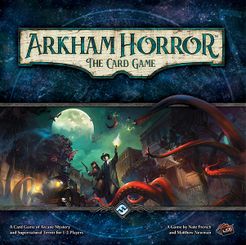
Designed by Nate French, Matthew Newman
Published by Fantasy Flight Games in 2016
The game features an exciting investigative aspect and utilises cards that convey the character of each player really well
Kingdom Death: Monster

Designed by Adam Poots
Published by Kingdom Death (self published) in 2015
This game utilises the key horrifying creature fighting and persistent world that will be key in our board game.
Slay The Spire

Designed and Published by Mega Crit Games in 2019
A digital card game, and so while a lot of aspects can be unwieldy to implement in a tabletop setting, a lot of the key features of our game can be traced back to this game.
Munchkin

Designed by Steve Jackson
Published by Steve Jackson Games in 2001
This game was a key inspiration for the AI deck that you fight against.
Horrors From Beyond
Designed by Us in now time.
The game is a horror card game based around climactic and difficult puzzle like battles against an AI deck. In the game players choose a character, consisting of a passive trait and 10 cards, and then adding a number of cards from a equipment deck store. Players then work together (or alone) to defeat a monster represented by a deck of cards that automatically play when drawn.
The key aspects that I was involved with was the initial various idea proposals, upon which we discussed between them which we preferred, which ended up being the Horror Card Game. After this was decided the basic idea for the rules was cemented down into game systems, which I wrote down and was then proofread and clarified with the other group members.
The theme was the next discussion, after making some suggestions that would allow us to explore the characters, and monsters, in a setting and narrative. I made some suggestions and gave a rundown on the various benefits and negatives of each thematic setting, until after some discussion with Olivia we arrived at the modern/scifi setting.
And so after that I created some basic ideas for flaws to integrate into cards for characters, and Olivia created some rough archetypes for the characters in terms of name, bio, and flaws. I then created the six monsters and the decks they would use, and the six characters and the cards they would start with, while Olivia began on the equipment cards.
The game still has some work to go before it is finished into a cohesive piece, and then we just need to prepare a presentation.
 mooshbag